You’ve said Steep Stims was about going back to basics, the spirit of working with limited gear and fast decisions. What drew you to that mindset?
It’s funny, I didn’t actually use old samplers for this record. What I meant was more the ethos of working with limitations. I like to imagine the album could have been made on a sampler from 1999, something with barely any memory. The palette is minimal: drums, synths, a few textures. A lot of modern electronic music has these long cinematic intros, plush sound design, and not enough juicy harmony. I always think, you couldn’t fit that on a sampler back in the day. I love music that’s straight to the point. Some people hear that directness as a hazard, as confronting, but I hear it as to the point. None of my tracks really linger. They just start, say what they need to, and move on. It’s almost ideological, this idea that you don’t have to pamper the listener. You don’t need the musical equivalent of someone rolling out the red carpet, greeting you at the restaurant door, and showing you to your seat, explaining the menu in great detail. Like, it’s food. Where is the food!
That sense of directness has been in your work since the beginning, right?
Yeah, and it’s something I’ve come to appreciate more. It doesn’t make the process easier, though. It’s actually harder to cut things down to the right size. I improvise a lot, and only a small fraction ever gets released. Maybe one fifteenth of what I make. The irony is often that the shorter the track is, the more work it takes to get there. I might jam for ten minutes and then spend weeks deciding which two minutes to keep. It’s like editing film – you fall in love with certain takes, but the final cut has to move with intent.
I think that you mentioned “No Pills U” being written in only twenty minutes.
Yeah, it was just one of those moments where the track writes itself. There was this feedback loop running from a tape delay on the Virus synth. I loved the tone of it. I recorded about an hour of it. The idea came instantly, but it took months of resistance, just listening to it on repeat, to not overwork it. Keeping a two-minute track at two minutes can be harder than stretching it to ten. It’s a sad happy piece of music. Like it’s almost impossibly happy and blissful. Music like that makes me sad for some reason, in a good way. I had the idea of it being for someone who had chronically used loads of ecstasy and depleted themselves, was depressed, in a hole, like you don’t need that. Give it up. No Pills U.
Let’s talk about the Virus! It’s all over this record.
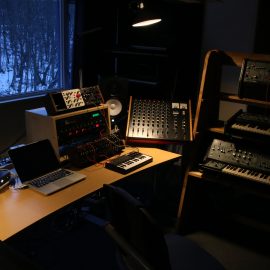
Totally. My friend Robin Fox runs this place in Melbourne called MESS, the Melbourne Electronic Sound Studio. It’s a huge synth workshop. You pay a small fee and can use anything you want – Moogs, Buchlas, modular rigs. In the corner was this battered Virus. It looked like the Millennium Falcon in repair mode. It’s not analog, not from the revered ’70s era, just a ’90s digital synth. But when I turned it on, the first patch I played became the riff for “Blowtorch Thimble.” That was literally the first sound I made on it. I kinda knew I had an album on my hands. When I got back to the UK, I bought one – all the presets were different, so I had to rebuild them by ear. It’s got this peculiar grit. Mine clips on certain notes. Annoying to mix, but beautiful. The onboard distortion and EQ are brutal and slightly unpredictable, which was quite new at the time. It’s got this digital steppiness to it – but warmth, you fall into the sound – a quality that modern soft synths just can’t do without a ton of tedious work, and it still kinda sounds like plastic surgery. I actually want to sell it now – I don’t like getting too attached to gear. I want each instrument to have its season and then move on.
You also used a real piano tuned to 18 notes per octave.
Yeah, 18EDO. Mental. I’m friends with a piano tuner named Angus Donald. He’s a total microtonal don! He’s written papers on it, he’s fully in there. But I got involved myself. It’s easier if you convert the piano to a single string per note with a Papps Wedge or a long mute. It’s a bit of a “unicorn” piano, although we christened it “the cyber spider.” It makes tuning simpler and the tone purer, less of that beating resonance. The thing about 18EDO is that it sounds subtly wrong until you clock the logic behind it. The minor third becomes a major second; only a few chords sound traditionally nice. But it’s great for gamelan-like runs, very fast, very fluid. It’s not the typical “out-of-tune” chaos; it’s precise, uncanny. It makes your ears perk up a bit.

Tell me about Throttle Records. Why release Steep Stims yourself?
Freedom, mostly. When I release through Throttle, I can put something out when I want, how I want. I run it with my manager, Greg Eden — he actually signed me to Warp years ago. We thought about approaching other labels, but honestly, it didn’t make sense. The royalty splits are better this way, and I avoid the whole promise-of-a-campaign thing that doesn’t always materialize. Throttle’s been growing naturally. The more we release, the stronger it gets. I’ve started signing other artists, too. My friend Mike Jefford just released an EP called Laguna Seca, which I’m really proud of. As for the aesthetic, it’s not a minimal techno label or a purely dance label. It’s just stuff Greg and I love: electronic music that feels alive.
You’ve moved through so many phases — IDM, techno, orchestral work, and even songwriting on Sus Dog — but there’s always something unmistakably “Clark.”
That’s kind, thanks. Honestly, I think I’m rewriting the same ten tracks over and over. There’s always a piano one, a techno one, a jungle one, a hip-hop one, a more interesting synth/acoustic harmony one, one with piano and drums, etc. My range isn’t that wide, ffs! It’s a vocabulary. I see piano and synths as part of the same continuum. People chase new patches endlessly, and like to have a pop at what they see as tradition, but really, piano is in it for the long haul. Maybe I’m wrong, maybe school kids will be whistling atonal Max/MSP patches in 13/5 in 400 years, but I’m hedging my bets. It’s like getting bored of fruit and veg or water, and saying hey why eat that, don’t you know HUEL exists now. It’s a tension, though – there’s also a lot of nonsense in the whole muso “real music” world. “Real Music Played By Real People For Real People”, it can get a bit blokey, a bit campaign for real ale. The spaces in-between, unresolved questions, that’s what I’m interested in, I guess. I also have an addiction to novelty/mental sounds. Sometimes I play my piano in digital mode on headphones, and I forget it’s digital. Your brain kinda fills in the gaps. Work that one out, hehe. The simulation can feel more real than real. Maybe the problem is when you play the piano, it feels like you’re pulling stuff out of thin air, it FEELS alive, you feel connected. But for the 2025 listener, it can often sound scripted because of its embedded history. They just hear “oh, it’s more piano”. I still love it though. In general, electronic music is so good, though, the best – it challenged all that stuff around the feelings/ego of the athletic performer. Artists could take a backseat and develop much more taste/ and imagination, more like a director mindset than an actor.
Has scoring for film changed how you approach your albums?
Not consciously, but it’s taught me a lot about recording and collaboration. Working on films, you have to speak in emotional terms, not technical ones. Directors will talk about a character’s trauma or redemption arc, and you’re thinking about whether you even wanna add reverb. So you learn to translate that emotion into sound. It also forces you to work fast. You might send off a cue you love, and they hate it. After thirty cues, you stop taking it personally. You just write another one. I’ll sometimes do ten pieces in five hours for a film. It’s liberating because the pressure shifts: it’s not about “your masterpiece,” it’s about problem-solving, it all sort of sharpens your wits – feeds into the mind-grist mill. It all feeds into albums-you don’t take writing studio albums for granted – I can’t imagine the inertia of doing nothing but solo studio albums into my forties. It freshens the context, you realise what it IS more.

Have you explored AI in your music-making process?
Only out of curiosity. Most of it leaves me cold. The whole “Johnny Cash sings Kanye over a Mozart beat” thing, that’s fast-food AI. It’s like ketchup sachets. Quantitatively successful but of no nutritional value whatsoever. Beyond a point that can sustain me continuing to be able to release music, I’m not interested in mega-quantity. Quality is the coin of the realm. Maybe AI is good for people with a passing interest in music, but that ain’t really my bag. If someone made a purely AI album that was as good as Endtroducing, I’d be all for it. I reckon it becomes more about curation after a certain point. What prompts you give. I’m not really into it. I’m a self-prompter. It did nudge me into learning a bit of Max/MSP, though. I like building simple generative sequences, but I always end up sculpting them manually. In the end, I always think this is getting a bit boring now, the work it would take to learn it. My thing is – I’ve got stuff I wanna learn on the piano, I don’t practice drums enough. If I had more time, I’d probably be into it.
You seem to thrive on that sense of curiosity — just poking at sound until something happens.
Completely. When I’m not trying to make a track, that’s when I make a track. Testing a synth, fixing a cable… suddenly a feeling comes out of nowhere. It’s about catching yourself off guard. You can’t plan that. Steep Stims came out of that kind of play — spontaneous, unselfconscious.
What’s next for you?
More music. Always. I’m talking with a few artists I really admire, but I can’t say who yet. I’ve got loads of material that I wanna finish. And live shows — Bristol, Paris, Berlin, London. Performing is nerve-wracking because I basically love being at home writing tunes. But you normally come back from a show with a head full of new ideas.
Steep Stims is currently out via Throttle Records on Bandcamp. Watch “Civilians” video, directed and choreographed by Melanie Lane. Clark is currently on tour, kicking off in Berlin today, then Brighton, Paris, Manchester and more. Full schedule of live performances is here.