Let’s start at the very beginning. Can you tell us how you got involved in composing, and what was your very first piece of gear?
Well, I learned to read music at a young age as I was in an extracurricular children’s choir called Riverside. Following that, I studied percussion in grade school. When I was 14 in the summer of 1999, I was put into the ‘drum line’ by default, even though I loathed the pseudo-militaristic nature of marching bands. While practicing in the scorching July heat, my friend lent me a CD-R of AFX’s Analogue Bubblebath (specifically, I remember the track Cuckoo). This was the genesis that really sparked my love for electronic music. After that, I got really into the music of The Prodigy, Scooter, and a lot of other electronic artists that were popular around the turn of the millennium. I also had phases where I was into trance and D&B, even seeing some great acts live as a teenager. I remember buying the CD ‘Tri Repetae’ at a record store run by the drummer of Pere Ubu and being very moved by that. In 2001, I started recording with a free version of Fruity Loops, and following that, I got into Audiomulch. For the proto-Emeralds jam sessions around 2005, I was doing more granular stuff with processed samples in Audiomulch on a desktop computer. So my introduction to composition was initially through software, not hardware. The first significant piece of gear that I can remember buying was the Moog Opus 3, which was shortly after the inception of Emeralds.
How many different studio iterations have you gone through, and what does your final setup look like right now?
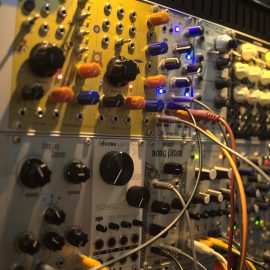
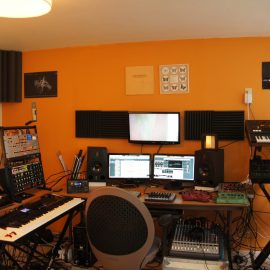
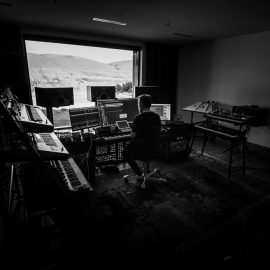
It’s hard to quantify iterations as the home studio has evolved and changed over time. In Emeralds, it was very primitive in the early days, so we were recording directly to cassette or even DAT. Solar Bridge was the first release of ours that I recorded from a mixer to a soundcard, which is why it sounded clearer than, say, Allegory of Allergies. Does It Look Like I’m Here? was also recorded on the same computer with (hilariously) Cool Edit Pro, although John was doing more of the mixing for that release. There was a major inflection point when all of my equipment was stolen in NYC in 2009. I had a guitar pedal-based setup (with Akai Headrush looper, Frostwave Resonator, etc.) with a Micromoog and JX-8P. After that, I changed my entire approach and purchased a Prophet ’08, which was a great complement to John’s Minimoog Voyager OS. I moved to Antwerp for a few months with Mark, and following that, I started using DAWs like Ableton Live and Reaper for my solo releases on Kranky Records. When I was flipping equipment on Craigslist in Ohio in the 2010s, a lot of synths were coming in and out all the time. That was how I acquired the original Oberheim OB-X, for example. But after a point, I didn’t really see as much of a use for many old analog synths as I was gravitating towards a more hybrid, connected setup via MIDI, which I was more comfortable with. I was not interested in maintaining a museum and instead favored utility, which could also extend to live performances. Another inflection point was when I finally started building a modular synth after I moved from Cleveland to Chicago. I had been interested in them since the mid-2000s because Audiomulch was essentially a digital, modular environment. The Wiard era was cool, before the popularity surged, but it was always out of reach for me, so I just admired my friends’ systems from afar. My setup at the moment is not a final one but one born of necessity. I relocated to Tbilisi in 2022 and could not bring my entire Chicago studio with me, as it’s very difficult and costly to transport here safely. My setup there, which I used for Aeropsia, was centered around the SSL Xlogic X-Desk with an Apollo x8 interface and Studiocraft Studio Patch DB25. With some outboard and 500 series modules that I patched in when mixing, in addition to all of the synths. So, unfortunately, much of it was put away into storage, and currently, I have a stripped-down setup which still revolves around Ableton Live, Sequential Prophet Rev2, the modular synth, an audio interface, some midi controllers, and a bunch of third-party plug-ins.

Tell us about your favourite piece of hardware.
I have really come to appreciate the Nord Modular G2. The workflow was super innovative and ahead of its time in many respects, especially with regard to patch mutating. It bridges the gap between software and hardware so well. Getting the editing software to run on 64-bit PCs now can be a bit of a pain, but otherwise I really like the architecture.
And what about the software that you use for production?
Since Tragedy & Geometry, I have been primarily using Ableton Live for most of my productions. When I go to other studios, sometimes we will use Logic or Pro Tools for certain tasks, but at home, I am almost always running the latest version of Live.
Is there a particular piece of gear that you’re just dying to get your hands on, and do you think one day you’ll have it?
I get sort of overwhelmed if I’m surrounded by too much equipment. That said, for outboard gear, I would love to one day own a Bricasti M7 as it’s one of the best reverbs I’ve ever used. I believe Sophie used one, if I’m not mistaken. But it’s hard to justify the price point when there are other alternatives that can approximate it. Regarding instruments, I would really like the Waldorf Iridium, as I used the Blofeld extensively for a couple of years.
Can you please share some aspects of sound design in your work?
I have leaned a lot more into transient shaping in the last few years. My SPL Transient Designer is currently in Rafael Irisarri’s studio. We used the plug-in version quite a bit on Dissolvi. As well, I have been using resonance suppressors for unintended purposes. You can really change the way things sound quite easily with only a few simple tools if you know what you’re doing. Automation is also very key to my working and mixing process. I used to shy away from it at first, but now it is entirely vital to everything.

Any particular new techniques that you tried out for your new album?
Yeah, the kind of guiding concept for the new album was interpolation. During the pandemic when I started recording the new album I was really inspired by the ‘The Oxford Handbook of Algorithmic Music’, the Nord G2 and this concept of ‘evolutionary synthesis’ or ‘genetic algorithms.’ I used the original Synplant on some tracks a few years ago, as well, which are on the new album (some did not make the cut as well). Then they released Synplant 2 in the last year, I think, which is much improved. I am really a fan of these more modern ways of thinking about patches that bring the aleatoric into the equation- treating sounds like beings that can change and not as static ideas. I like the idea of guiding or mutating sounds as opposed to the notion of traditional patching, playing synths by hand into a looper, or endless AI slop, which all can get quite tiresome.
What does your live setup look like, and what do you bring with you when you travel for an extensive tour?
My limited home studio setup at the moment is basically the same as my live one. It’s centered around a small Steinberg audio and MIDI interface. MIDI info is sent to plugins, Prophet Rev2 & modular on different channels. When it hits the modular, it’s converted to CV, which is output as notes, triggers, and gates. Then everything gets multiplied and sent out all over. In Ableton, there are around 30 channels running during a live performance, but there are 8 main ones I am live mixing with a Novation Launch Control XL, as everything is getting bussed to those. I’m not really using a traditional mixer per se on stage, only the one at front of house.

What is the most important environmental aspect of your current workspace, and what would be a particular element that you would improve on?
I find myself using headphones a lot of the time, as it helps drown out a lot of the noise of living in a city. Moving somewhere idyllic and quiet would seem beneficial, I think. But even in the countryside, there’s still a lot of noise, like roosters, to contend with. There are positives and negatives to weigh, of course.
What can you tell us about your overall process of composition? How are the ideas born, where do they mature, and when do they finally see the light?
Usually, I start with a longer improvisation of some sort that can range from 10 minutes to over an hour. From there, I ascertain if there is anything interesting or usable. I rely on instinct and intuition to infer if there are elements that could work or be extrapolated upon. So there is a whittling down process before overdubs start. Then there is a process of layering, and once I have all of the tracks recorded, the mixing process can take several months. Usually I am juggling a lot of tracks at once so it takes awhile. Every mix goes through many different revisions before it’s processed through 500 series EQs, etc. Then it’s off to the mastering engineers.

After the piece is complete, how do you audition the results? What are your reactions to hearing your music in a different context, setting, or sound system?
I like listening in different environments, scenarios, and studios- not just on the main monitors and headphones. I will even listen in cars and with cheap earbuds to get an idea of how it sounds. Most of the time, my reaction to hearing the mixes in a new context is one of either revulsion or surprise. But it’s good because it gives you another way to think about how it sounds out in the wild.
Do you ever procrastinate? If so, what do you usually find yourself doing during those times?
I started playing online chess a lot over the last few years. I improved to the point where my Elo rating has approached 2000, which places me in the top 1%. That may seem impressive at my age, but at the higher levels of chess, it becomes almost impossible to beat someone who is, say, 200 points higher than you. I prefer both Rapid and Bullet chess, but for some reason, I struggle with Blitz a bit more. I think the epidemic of cheating has had an impact on the landscape of online chess in the last couple of years, so it’s best not to take it too seriously. As a result, I’m now playing more anonymous games that don’t affect my rating. Maybe one day I will aim for a Candidate Master title, although it would require some coaching.

And finally, what are your thoughts on the state of “electronic music” today?
I’m not really one who has their finger on the pulse of what’s going on. But music at large has been in a rather precarious place for a while now. Many systems are in place that make it difficult to be a functioning artist in society. Additionally, some electronic musicians have entirely the wrong idea about how to go about making or listening to things. Sometimes it seems like there is a weird sonic imperialism or competitive drive behind some music. My background is simply different from people jumping right into ‘ambient’ or whatever- I was sort of bored with IDM, techno, ambient, etc. as a teenager, and that’s why noise and experimental music seemed so liberating as a form in the early to mid 2000s. Then I came back around to electronic music later through a completely different lens. For me, it was crucial to be able to listen to something and be mesmerized by it without knowing how it was made. That mystery or veil over the productions in the pre-iPhone society was what inspired me to make music.
Editor’s Note: Steve is doing a Reddit AMA, today!, Wednesday, October 22nd, 2025, 11 am EST (8 am Pacific, 4 pm UK, 5 pm Paris/Berlin) on the r/electronicmusic (with the r/ambientmusic also cross-posting about it too).