It’s been over a decade since our last studio conversation. You mentioned moving into a new place in 2021. How has this new environment shaped your creative process compared to the spaces you’ve lived in before?
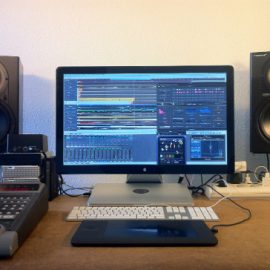
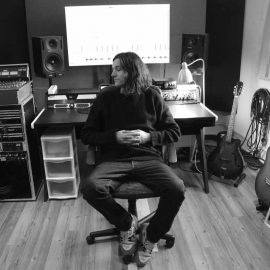
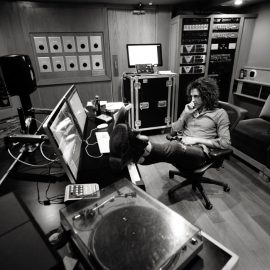
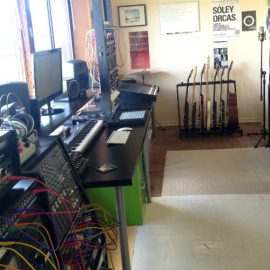
I moved a bit further out to the edges of Tokyo, and it gave me more space to dedicate a room completely to music and instruments, and to have my gear out and connected. Of course, duh, it helps to have everything accessible and connected, but after years of moving around and living in small spaces, it’s a first. It helps me to keep my focus and not waste so much time setting things up.
So, what does your hardware setup look like now?
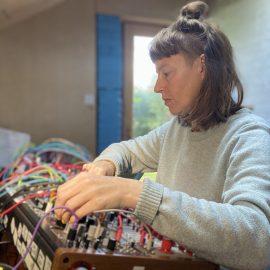
Basically, I have all my rack gear of effects, samplers, etc, connected to audio interfaces and a mixer. All MIDI-capable gear is also connected to a MIDI patch bay, which I can control from the computer, as well as plug in any synth or drum machine, and have everything synchronized by tempo. I usually only play and record one instrument at a time, and put it all together slowly, piece by piece, but this setup allows it to be easy to get out whatever I want to work with and plug in. I keep most of my synths and drum machines in cases or the closet, but it’s all accessible. I also have a turntable connected for sampling vinyl.

In the past few years, you’ve been exploring house, acid, and jungle. What led you from long-form ambient works into these more rhythm-driven styles?
As we grow and go through the changes of life, so do the ways we create. I don’t want to say that I won’t ever make the same tape loop-based music or minimal ambient that I did for so many years, but at a certain point in 2020 or 2021, I just wanted a change. I also turned 40 in 2020, and life does change drastically per decade.
My interest in branching out had already started several years before, when I put out my debut deep house record “Long Trax” on Comatonse, and I enjoyed creating with different instruments, in a completely different way, and for a completely different purpose than what I had done before. The same appeal led to acid house, and jungle, and a lot of that is the instruments used, and getting back to the roots of the music.
Though there are different instruments, tempos, and concepts, I think there are many similarities between what I’ve done before and what I’ve been doing recently. It’s coming from the same place.
But of course, I also like these other types of music, and wanted to pay homage to those styles and artists that I like, while giving my own interpretation.
During and after the pandemic, I also began to feel that the world had changed, and long-form ambient music wasn’t the kind of art I wanted to contribute. Go back to the roots. Make it more raw. Avoid becoming a playlist for everyone’s relaxation.

How has your sound design evolved over time?
When I worked with tape, it was much more loose, like working on layers of waves overlapping, and capturing an image, idea, or memory. I think jungle music covers a lot of those areas, and it’s similarly flexible in creating a feeling and an environment, but it’s a different kind of hands-on approach. Deep house is really compelling to me in creating a mood, and it completely aligns with my interests in activists, as in the inspired speeches, and with the underground aesthetic that it originated from (not necessarily what it’s become). Acid house is also a bit divergent and a much more improvised style, which feels very much like harnessing energy and warping it into different forms. This, of course, does not mean “buildups”, but intensity. In so many ways, many of these aspects are a different side of the same coin from where this paragraph began.
Do you approach making beat-based music with the same tape-driven, hands-on philosophy you described before, or has your workflow evolved into something new?
It is definitely hands-on – for example, the Roland rhythm machines and their grid-style programming, to chopping beats and samples on a tiny Akai LED screen, and twisting the knobs on sequences of the 303. In this way, it’s much more hands-on, as opposed to tape, which is more like a film laboratory, a lot of the time.

You’ve emphasized the value of limitations. In today’s world of endless plugins, samples, and software, how do you still create those boundaries for yourself?
This is something I particularly enjoy about exploring different styles, and jungle is a particularly good example. It was perfectly aligned with my interest in appreciating limitations within instruments, since many of the same instruments used by jungle artists in the mid-1990s are many of the same instruments I enjoy using, such as Akai hardware samplers like the S1000 and S900. And using these machines, they all have slightly different capabilities, and different uses, and to work within those limitations – such as memory space, for example, the S1000 can only hold 2 MB of sounds – you have to be very creative to sequence rhythms or samples working within that space. And there’s no saving, except on a floppy disk, so when you turn the machine off, everything is gone. You have to work within the moment.
Also, instead of just searching for samples online, I wanted to go about finding source material the old-school way, by digging for vinyl records and finding the samples myself. Surprisingly to me, some of my favorite drum breaks that I’ve found were not among the more well-known and sampled, though I also love all of those as well. The idea of jungle using pitched-up drum breaks is also appealing to me, just as it was using slowed-down samples for tape loops previously. It’s just the same idea going in a different direction for a different purpose.

You once told me the Sony Tapecorder 262 was your most treasured piece of hardware. Do you still find yourself reaching for tape, or have newer tools become central to your process?
Unfortunately, my Sony Tapecorder 262 finally bit the dust a few years ago, but I still have a Uher 4000 Report Monitor for those tapes. I don’t use tape much for recording anymore, but I do still like to use cassette tapes, Walkmans, and Portastudios when I play Celer shows.
Much of your earlier music was memory-driven and deeply personal. Has working in other genres unlocked a different side of storytelling for you?
It’s all part of growing and carrying those changes with you. I try not to worry about the future, to stop trying to plan what I’m going to do or make, to stop looking for endpoints, and just do what feels right, and let the road take me where it will.
Memory will always be there, but there are many ways to process it. It doesn’t always have to involve sharing explicitly personal stories. I found a lot of comfort and inspiration in the rigid structure of rhythm machines, sequencing synthesizers, and discovering new sounds and feelings outside of my own experiences and memories. And of course, staying on a course, following a schedule or system keeps you on track mentally, and keeps you focused.
As for storytelling, I think these different styles of music, whether it’s deep house, acid house, jungle, or ambient, all tell a story from within ourselves. It’s just a different vehicle.

In our first talk, you said you produce more than you can release, and that the release process felt like “work.” Has your relationship to output and publishing shifted in the last ten years?
I’m sure that comment was potentially the tiredness of the emotional weight and processing that I was putting into the music and experiencing, as I look back now. I hope that in the last 10 years, I’ve come to develop a more disciplined and focused sense of direction. I don’t really care if it’s not as popular or if no one is asking for it. I’m just following the path that’s most interesting to me. Creation also changes over time, as we and the world do.
Finally, do you imagine these different strands of your work merging into a single voice, or do you see them continuing as separate, parallel paths?
To me, it all feels like a single voice and stream, traveling on a winding path. It may wind in many different directions, but I think it’s all part of a singular, evolving stream. Who knows where things lead? That’s part of the experience.